

Let's Evaluate The Voting Records Of Indiana Republicans Who Opposed Redistricting
Can you trust records like this?

By now, everyone knows that 21 Indiana GOP state senators voted against the state redistricting. As a result, primary challengers showed up to run against these Republican incumbents.
However, for many, it isn’t JUST the redistricting vote. It’s the totality of these senators’ records. Dr. Brian Schmutzler said as much when I interviewed him. He’s challenging Sen. Linda Rogers. He said her redistricting vote was the straw that broke the camel’s back.
Most Hoosiers already know the drill … good legislation will happen in the House, and it will get killed or mauled beyond recognition in the Senate.
Of course, the incumbents are trying to make the case that they are the true conservatives, and this effort to vote them out of office is a Washington, D.C. conspiracy based on just one vote.
Well, let’s look at their records with a broad brush.
I pulled their conservative ratings from some groups that grade local politicians, just as we have ratings for federal politicians.
A score of 0 represents liberal votes. A score of 100 represents conservative and/or constitutional votes. The higher the score on their voting record, the more conservative the politician seems to be. The lower the score, the more liberal their record.
Freedom Index makes these ratings available on its site. You can then analyze specific legislation that the lawmakers voted on to evaluate the rating. I took the liberty of putting together the following graphic with the GOP senators who voted against redistricting (not all are up for reelection), with their Freedom Index scores.
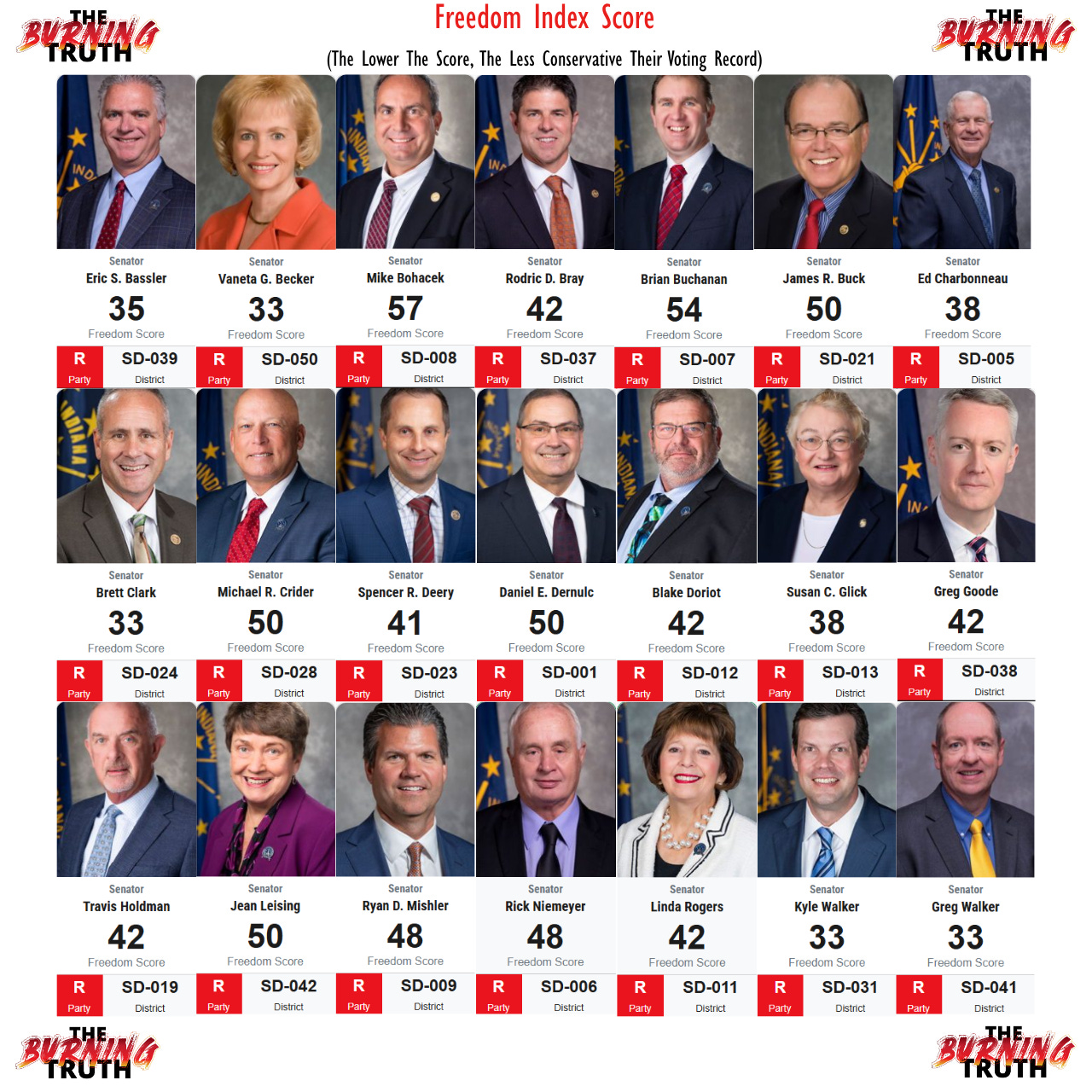
If we were still in school, all of these GOP senators would have a failing grade for constitutional voting in the 2025-2026 session.
Democratic Senator Mark Spencer has a score of 40. That’s better than several of the Republican senators who voted against redistricting. Seven of them, to be exact. Let that sink in … a liberal Democrat in the Indiana Senate has a higher rating than these Republican senators, but you are supposed to believe they represent conservative Hoosier values? Can we also pause for a minute to absorb that Sen. Mike Bohacek has the HIGHEST score in this group? That’s … well … sobering.
The best Freedom Index score in the Indiana legislature is Rep. Andrew Ireland with 83%.
If you look at their lifetime Freedom Index score, some of the senators do have a better score than they did in the last session, but not all. For some, like Sen. Linda Rogers, their lifetime score is actually even worse. Hers drops to a 33%.
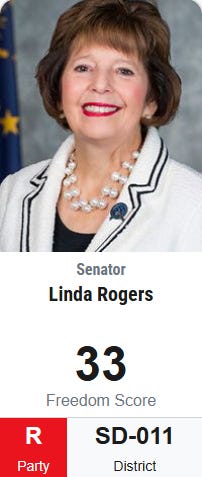
Now, this is one source. It doesn’t paint a total picture of their record, and you should keep that in mind. Use their legislation tool to dive into the issues most important to you.
Now let’s look at CPAC’s scores. CPAC is generally seen as a moderate-right organization that builds the ‘big tent’ in the Republican Party. So they aren’t hardline conservatives. For many of you, you may see their scorecard as more representative of the general base of the party. These scores are only through the 2022 session, and only include lawmakers who were in office at the time.
Sen. Bassler - 65%
Sen. Becker - 50%
Sen. Bohacek - 64%
Sen. Bray - 71%
Sen. Buchanan - 78%
Sen. Buck - 76%
Sen. Charbonneau - 67%
Sen. Crider - 66%
Sen. Doriot - 74%
Sen. Glick - 69%
Sen. Holdman - 70%
Sen. Leising - 73%
Sen. Mishler - 69%
Sen. Niemeyer - 73%
Sen. Rogers - 73%
Sen. Kyle Walker - 60%
Sen. Greg Walker - 62%
Through the 2022 session only, you see that their lifetime scores with CPAC are better overall, but still not great. Many of those scores likely would have fallen after the 2022 session. For conservative Hoosiers, this is something they’ll have to consider.
Sen. Linda Rogers was on my show recently as well. She said she didn’t like the way the 2nd District was drawn. She called it ‘too risky’ for Congressman Rudy Yakym.
She isn’t the only GOP senator who voted against redistricting who said that. The problem is that I can’t seem to find any evidence to back up this claim.
Since Indiana redrew its maps in 2021, the 2nd district has had Republicans win by 9.6 points in 2022 and 32.2 points in 2024. For the record, 9.6 points is considered a large majority. Don’t let the massive 2024 number dilute that fact.
So, if Sen. Rogers is right about redistricting potentially harming the now safe 2nd district, we have to see that 9.6 point minimum advantage disappear with the redrawn maps.
We just don’t see that.
All of the analysis I can find on the 2nd congressional district shows that the district would have actually been a stronger Republican district after redistricting if it had passed.
Rep. Ben Smaltz (R), the bill’s author, said:
“These maps were specifically drawn for a political advantage.”
He said it would explicitly benefit the 2nd district.
The Princeton Gerrymandering Project analyzed the proposed new maps and found that the 2nd district would be even safer for the GOP.
The Chicago Tribune, Politico, PBS, WFYI, etc., all show that the proposed new maps would have INCREASED the 2nd district’s advantage for the GOP. Liberal outlets were outraged by the maps.
Under the current map, the 2nd district is +14 - +20 for the Republicans. The proposed redistricting map would have pushed the 2nd district closer to +20 by design for the GOP. There doesn’t appear to be any data showing the 2nd district losing its minimum 9.6 point advantage for Republicans.
I even ran the numbers through Perplexity just to see if I missed something. Its analysis was that redrawing the maps to gain two Republicans in Congress would have actually helped the 2nd district, not hurt it. Of course, there’s no accounting for human behavior. We are only running the math here.
Sen. Rogers did say she heard from constituents who didn’t like that they were being moved out of the 2nd district and into the 3rd. That is very true, the 3rd district would have taken several areas from the 2nd. Many of which used to be in the 3rd before 2021. However, 3rd district Congressman Marlin Stutzman is similar to Congressman Yakym in ideology, and the 3rd district is heavily Republican.
Respectfully, the senators who are claiming the new maps would have harmed the GOP don’t seem to be telling the truth. They don’t seem to have any data proving their case. A case most have only just started making after they got primaried. Perhaps that’s why most of them avoided discussing the numbers altogether during the redistricting fight.
Scoring a politician’s voting record like this isn’t meant to be an attack on them as people. It’s not meant to be dismissive of the good that they’ve done. The fact remains, Republican senators who voted against redistricting have failing voting records for conservative Hoosiers, and their records aren’t much better for moderate Republican voters.
The questions for Hoosiers are simple: Are state senators who uphold conservative Republican values less than half the time good enough for you? Are lawmakers who can be trusted on a few issues, but can’t be trusted on other major issues, worth keeping in the state senate? Should you continue to be frustrated with the current crop of lawmakers in the state, or is it time to take a chance on somebody new?
I would be interested in knowing where Dr. Brian was during COVID.
Did he support the lockdowns? Did he enforce mask mandates? Did he warn the public about the dangers of treatments such as Remdesavier? Did he fight against the tyranny of COVID policies? Did or does he support the vaccines?
As a doctor, he had a responsibility to step up, be informed and take a stand. As a doctor, if he didn’t do the right thing on COVID, how can we trust him to do the easy stuff in Indy.
Any doctor without a track record, who wants to run as a conservative and be taken seriously needs to have been on the right side of COVID.
Do we know any of these positions?